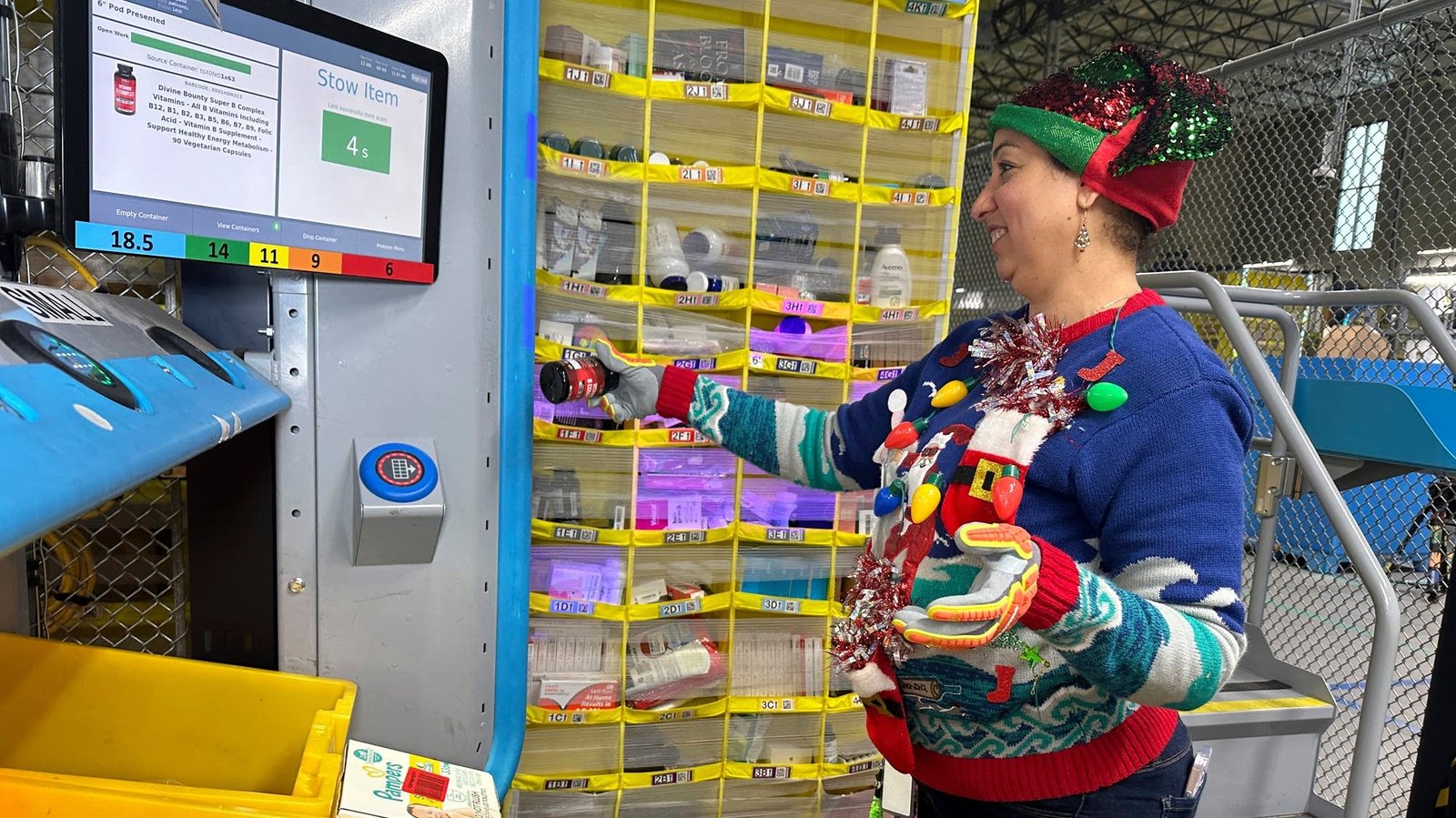
Uncertainty about the economy and tariffs is forcing many retailers to be cautious about holiday hiring
Uncertainty about the economy and tariffs is forcing retailers to scale back or delay plans to hire seasonal workers who pack orders at distribution centers, serve shoppers in stores and build holiday displays during the most important selling season of the year.
Dan Casterella, CEO of American Christmas LLC, which creates elaborate holiday installations for commercial properties such as New York’s Rockefeller Center and Radio City Music Hall, said it plans to hire 220 temporary workers and is ramping up hiring about two months later than usual. Last year, the company welcomed 300 people during its busy period.
The main reason? The company wants to offset the tariff bill, which Casterella expects to reach $1.5 million this year, more than double last year’s bill of $600,000.
“The problem is that if you overstaff and then underperform, it’s too late;" Castrella said. “I think everyone is more aware now than ever before.”
Holiday employment may fall to its lowest level since 2009
Employment firm Challenger, Gray & Christmas expects hiring during the last three months of the year to fall below 500,000 jobs. This is below last year’s level of 543,000 and also represents the smallest seasonal gain in 16 years when retailers hired 495,800 temporary workers, the company said. The company said the average seasonal increase since 2005 was 653,363 workers.
Other companies cutting holiday pay include Radial, an e-commerce company that delivers for about 120 businesses like Lands’ End and Cole Haan and operates 20 fulfillment locations. Sabrina Norowski, chief human resources officer, said she plans to hire 6,500 workers, down from 7,000 last year, and is waiting until the last minute to ramp up hiring for some of her clients.
Bath & Body Works, based in Reynoldsburg, Ohio, said it plans to hire 32,000 workers, down from 32,700 a year ago.
Among the bright spots: Online giant Amazon announced Monday that it intends to hire 250,000 full-time, part-time and seasonal workers for the crucial shopping period, the same level as it was a year ago.
“We have seen real strong signs that there is a slowdown in the labor market, even beyond our expectations in the first nine months of the year,” said Andy Challenger, Challenger senior vice president. “We have a lot of regular conversations with companies about pending layoffs and the changes they’re making to their workforce.”
In addition to general economic uncertainty, Challenger has noticed companies using… artificial intelligence Robots to replace some workers, especially those who work in call centers. He also sees companies hiring workers sooner when they need them.
Meanwhile, the list of companies remaining tight-lipped about their specific holiday hiring targets continues to grow. Target Corp, UPS and Macy’s decline to provide numbers, a departure from the past. UPS hired 125,000 seasonal employees last year, while Target announced last year that it planned to hire 100,000 workers. Macy’s said last year it would hire 31,500 seasonal workers.
Holiday hiring: The first clues to what spending holds
Retailers’ hiring plans are the first clues to what the US holiday shopping season has in store, and come as the US job market is experiencing… Lost momentum this yearPartly because Trump’s trade wars It has created uncertainty that paralyzes managers trying to make hiring decisions.
the Work section A newspaper reported in early September that U.S. employers — corporations, government agencies and nonprofits — added just 22,000 jobs in August, down from 79,000 jobs in July and well below the 80,000 jobs economists had expected.
The government shutdown, which began on October 1 and delayed the release of economic reports, may worsen the jobs picture.
In an attempt to put more pressure on Democratic lawmakers as the government shutdown continues, the White House Budget Office said so on Friday Mass layoffs of federal workers began.
The dismissals are occurring as hundreds of thousands have already been furloughed and others are still being asked to report to duty without pay.
Analysts will closely monitor the impact of the lockdown on spending. For now, many retailers say consumers, though flexible, are choosing what they buy. Analysts will also be closely watching how shoppers will react as retailers push price increases as a result of higher tariff costs in the next few months, experts said.
Given the economic slowdown, holiday spending growth is expected to be lower than a year ago, according to many forecasts.
Mastercard SpendingPulse, which tracks spending across all payment methods including cash, expects holiday sales to rise 3.6 percent from Nov. 1 through Dec. 24. This compares to an increase of 4.1 percent during the same period last year.
Deloitte Services LP expects holiday retail sales to rise 2.9 percent to 3.4 percent from Nov. 1 through Jan. 31. This is compared to the same period last year when retail sales increased by 4.2 percent over the previous year.
Adobe expects online sales in the United States to reach $253.4 billion this holiday season from November 1 to December 31, representing growth of 5.3 percent. This is lower than last year’s growth of 8.7 percent.
More flexible approach
Given the uncertainty, companies increasingly want to hire workers closer to when they need them, experts said.
“In today’s environment, brands are really looking to be flexible,” Radial’s Wonorowski said. “Radial is meeting client and consumer needs with a more flexible and disciplined approach to hiring.”
For some of its clients, Radial will now be hiring two weeks before the Thanksgiving holiday, the traditional start of the holiday shopping season, instead of four weeks before kickoff, she said. Radial is also accelerating employee holiday training thanks to new technology that streamlines their tasks. She said it used to take a few days to train a worker, but now it only takes a few hours.
Meanwhile, Target said it is once again adopting a three-pronged approach. It first starts by offering overtime to existing workers, then moves to a separate group of workers — 43,000 — who choose shifts that fit their schedules. The Minneapolis-based company said it is also hiring seasonal workers across nearly 2,000 stores and more than 60 distribution facilities to meet demand.
For the past few years, Walmart, the nation’s largest retailer and largest private employer, has been offering holiday overtime to its workers, a Walmart spokesman said, noting that it has worked well and that feedback from customers and workers has been “very positive.”
The Bentonville, Arkansas-based retailer said there may be some seasonal hiring on a store-by-store basis, but the majority of stores will distribute those hours to existing workers.
The late start combined with the lack of economic data can create challenges
Waiting until the last minute to hire workers could mean a frantic scramble to find talent, but companies say that because of the slowing economy, they do not expect to have difficulty finding the required pool.
Meanwhile, the pause in economic reporting leaves retailers uncertain about forecasting sales and the workers they need to meet demand.
“Our customers not having access to data will certainly pose a greater challenge to their ability to forecast,” Radial’s Wonorowski said. “But we will stay very close to them when we reach the peak and we will adapt as soon as we see things changing.”
Share this content:













Post Comment